

How Do You Get Privacy Without Blocking Natural Light?
Getting privacy without blocking natural light comes down to choosing a film that scatters light instead of stopping it. Frosted and etched films diffuse light so the room stays bright while shapes on the other side become unreadable. Gradient films block the lower portion of a window and leave the top clear, which works well where the privacy concern is at eye level. Patterned and decorative films break up the view without reducing transmission much at all. Reflective solar films create daytime privacy from outside while leaving the view out completely intact, with the important caveat that the effect reverses after dark. Blinds and curtains solve the same problem by removing the daylight entirely, which is why so many rooms end up permanently dim. This guide covers each option, where it fits, and the mistake most people make when choosing.
Table of Contents
- Why Blinds Are the Wrong Tool
- Frosted and Etched Films
- Gradient and Banded Films
- Patterned and Decorative Films
- Reflective Films and the Night Problem
- Choosing Privacy Without Blocking Natural Light
- Frequently Asked Questions
Why Blinds Are the Wrong Tool
Blinds and curtains are the default answer and they solve privacy by subtraction. Closed, they remove the view, most of the daylight, and the reason the window exists.
What happens in practice is that they get closed for privacy and stay closed, because opening and closing them daily is a chore nobody keeps up. The room becomes permanently darker, artificial lighting runs longer, and the space feels smaller than it is. In a Florida house with good glass and good light, that is a real loss.
Film works differently. It is permanent, requires no operation, and is engineered to separate two things that blinds treat as one: the passage of light, and the transmission of a clear image. Daylight in a home is worth protecting, and ENERGY STAR covers how glazing choices affect a building more broadly.
Frosted and Etched Films
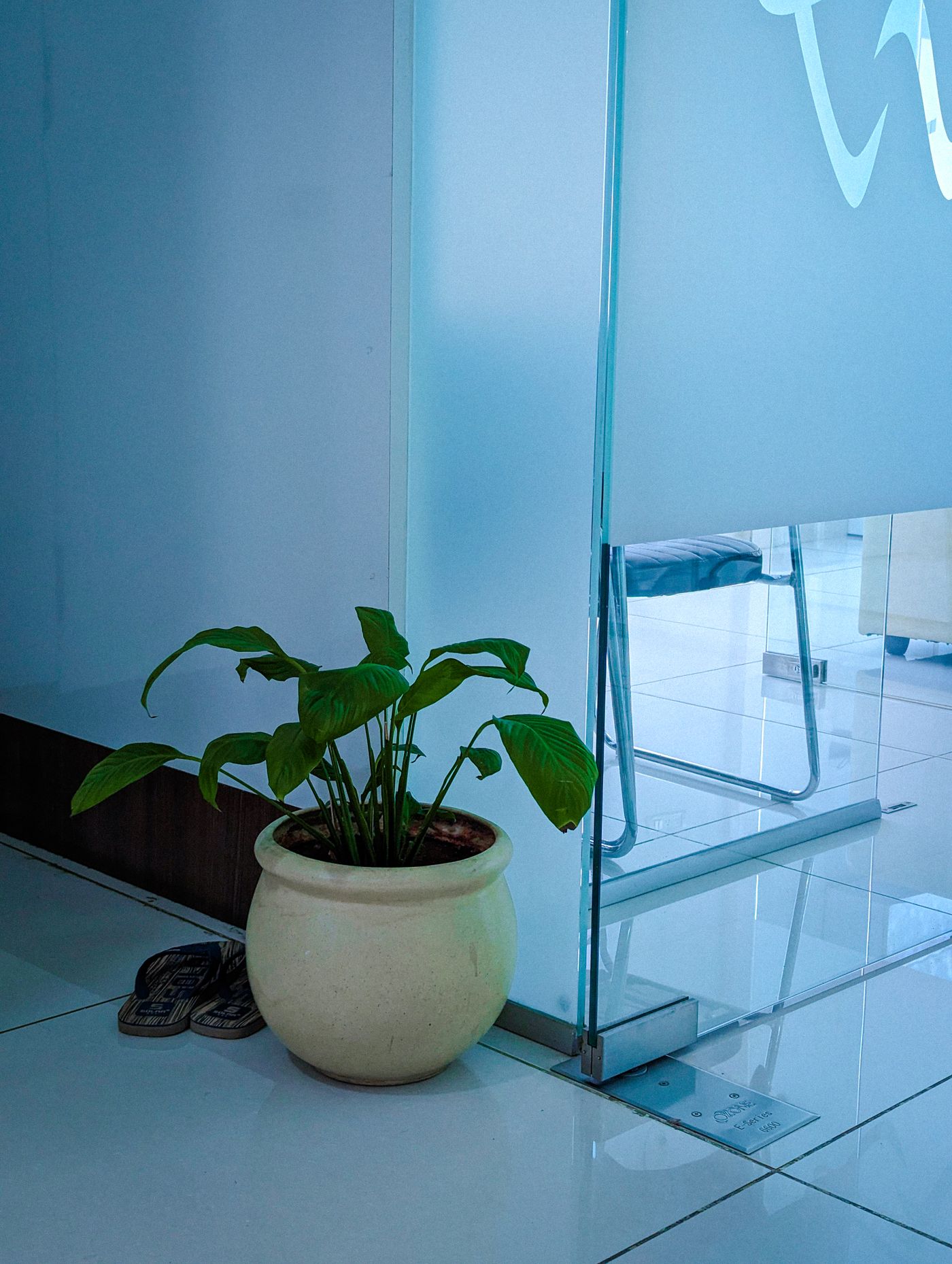
The workhorse of privacy film. A frosted or acid etched appearance film scatters light passing through it, so the glass glows evenly and nothing on the other side resolves into a recognizable image.
Light transmission stays high, which is the whole point. A bathroom window with frosted film is still a bright bathroom. A glass office wall with frosted film still borrows daylight from the perimeter into the interior.
It is the right choice for bathrooms, ground floor windows facing a walkway or a neighbor, glass entry doors and sidelights, interior office partitions, and any situation where the view is not worth keeping. It is the wrong choice where there is a view you want, because it removes it in both directions permanently.

Gradient and Banded Films
This is the option most people do not know exists, and it is often the best answer.
A gradient film transitions from opaque at one edge to clear at the other. A banded film puts a frosted strip across part of the glass and leaves the rest untouched. Either way, you block the portion of the window where privacy matters and keep the rest clear.
The logic is simple once you think about sight lines. A person standing outside sees into a room at roughly their own eye height. Block a band at that height and the privacy problem is solved, while the glass above stays clear for daylight and sky view and the glass below stays clear too.
It works particularly well on tall windows, glass doors, conference rooms where seated occupants want privacy but the room should still read as open, and street facing ground floor rooms. Our decorative film page covers the pattern options.
Patterned and Decorative Films
Patterned films use texture, line work, dot patterns, or custom graphics to break up the image without heavily reducing light transmission.
The privacy they deliver is partial and depends on distance and lighting. A fine dot pattern obscures detail at a few feet and less so directly against the glass. That is fine for a lot of applications, because the requirement is often to prevent casual viewing rather than to make a space genuinely unobservable.
Where these earn their place is branding and design. A custom pattern on a storefront or office glass does a job that frosted film cannot, and for glass walls there is a practical safety argument too: a large expanse of clear glass is something people walk into, and a manifestation pattern at eye height prevents that while adding privacy.
Reflective Films and the Night Problem
Reflective solar films give one way privacy during the day, and this is the option people most often misunderstand.
The effect depends entirely on which side is brighter. In daylight the exterior is far brighter than the interior, so the outside face acts like a mirror and the inside stays clear. You get full view out, daytime privacy, meaningful heat rejection, and ultraviolet blocking, which also protects furnishings and skin. The EPA covers ultraviolet exposure and why reducing it matters.
After dark the relationship inverts. With lights on inside and darkness outside, the interior becomes the bright side and people outside can see in. Anyone relying on reflective film for nighttime privacy is relying on something that does not work. Rooms needing round the clock privacy need frosted, gradient, or patterned film, or a shade for the evening. Our post on the best window film for Florida homes covers the solar control side in more detail.
Choosing Privacy Without Blocking Natural Light
Four questions settle it.
- Do you want the view out? If yes, gradient, patterned, or reflective. If no, frosted is the simplest and most effective.
- Do you need privacy at night? If yes, rule out reflective on its own.
- Where is the sight line? If the problem is at one height, a band solves it and leaves the rest of the window working.
- Is heat also a problem? If the window is sun facing, a solar control product handles privacy and heat together rather than solving them separately.
One more consideration for interior glass: switchable film gives privacy on demand rather than permanently, which is worth knowing about before committing to a fixed solution. Our smart glass film post covers how that works.
Frequently Asked Questions
Does frosted window film make a room dark?
No. It diffuses light rather than blocking it, so the room stays bright while the view through the glass is obscured. That is the key difference from a blind.
Can you see through privacy film at night?
Frosted, gradient, and patterned films work regardless of lighting. Reflective one way film only provides privacy while the outside is brighter, so it does not work after dark with interior lights on.
Is privacy film permanent?
It is durable and long lasting but it can be professionally removed. Our post on how film performs on Florida glass covers service life expectations.
Can privacy film go on a glass shower or interior door?
Yes, and interior glass is one of the most common applications. The film is applied to the dry side, and the glass type should be confirmed before installation.
Ready to Keep the Light and Lose the View In?
NBI SunControl installs decorative, frosted, and gradient film across Sarasota, Manatee, and Charlotte County. Request a quick quote and we will look at the sight lines with you.