

What Window Film Works Best for a Medical Office?
Window film for a medical office is rarely one product, because a practice has four different glass problems in four different rooms. Exam and consultation rooms need privacy, which means frosted, gradient, or switchable film depending on whether the glass is interior or exterior. Waiting areas need solar control to stay comfortable without going dark, since patients sitting by a sunlit window in a Florida afternoon are uncomfortable in a place they are already anxious about. Reception and clinical workstations need glare control, because screens carrying patient records are hard to read against bright glass and are also visible to anyone standing at the desk. And entrances, sidelights, and interior glass partitions benefit from safety film that holds glass together if it breaks. This guide covers what to specify room by room and what to confirm before installation.
Table of Contents
- Window Film for a Medical Office: The Four Jobs
- Exam and Consultation Rooms
- Waiting Areas
- Reception and Workstations
- Entrances and Interior Glass
- What to Confirm Before Installing
- Frequently Asked Questions
Window Film for a Medical Office: The Four Jobs
Before choosing products, separate what each area of the practice actually needs. Most specification mistakes come from treating the whole suite as one problem.
- Privacy. Patients need to be unobservable in clinical spaces, and that requirement does not pause when the light changes.
- Thermal comfort. Waiting rooms and perimeter offices with sun exposure get uncomfortable in a way that shows up in patient experience.
- Glare control. Clinical staff read screens all day, and screens near glass are both hard to read and easy for others to see.
- Glass safety. Entrance glass, sidelights, and interior partitions are impact risks in a building full of people, some of whom are unsteady.
Handle them separately and each room gets the right product. Handle them together and you end up with one compromise film that does none of the four well.
Exam and Consultation Rooms
Privacy here is the non negotiable requirement, and the right product depends on which glass you are treating.
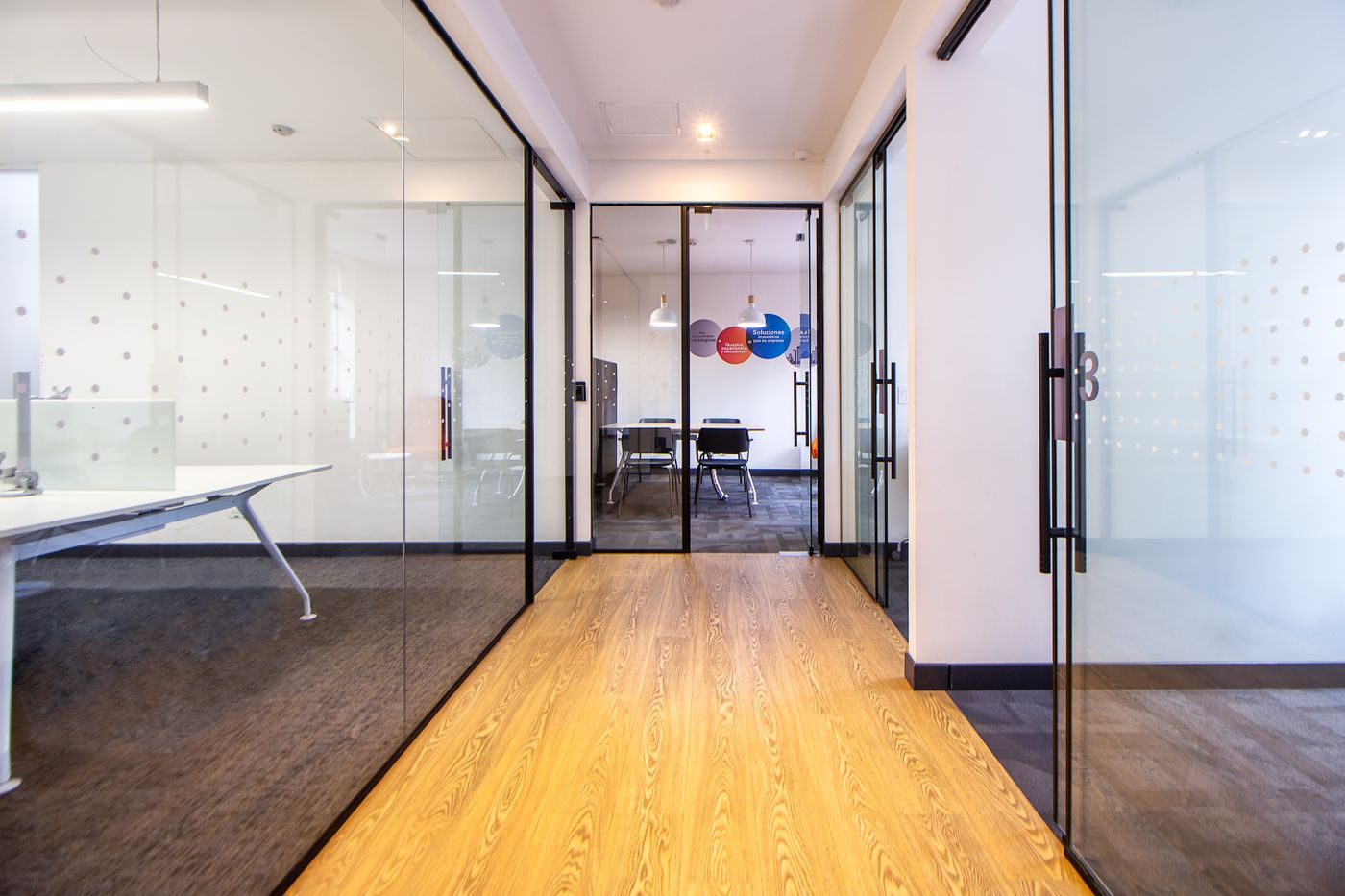
For interior glass partitions and doors, frosted or etched film is the straightforward answer. It obscures the view completely while letting the borrowed daylight through, which keeps an interior exam room from feeling like a box. Gradient film is a good alternative where you want privacy at seated and standing eye level and clear glass above.
For rooms that need to be private sometimes and open at other times, switchable film is the better fit. A consultation room that reads as open and welcoming between appointments and goes private the moment a conversation starts is a genuinely better room than one permanently frosted. Our post on smart glass film covers how that works.
For exterior windows in clinical rooms, the important point is that reflective one way film is not adequate on its own. It provides privacy only while the outside is brighter than the inside, so an exam room used in the evening with lights on is visible from outside. Clinical spaces need a product that works regardless of lighting.

Waiting Areas
Waiting rooms are usually the most glazed part of a practice and the part where comfort is most visible to patients.
A spectrally selective solar control film is the right specification. It rejects a large share of the infrared energy that makes a sunlit seat uncomfortable while keeping visible light transmission high, so the space stays bright and welcoming rather than dim. Patients should not be choosing seats based on which ones are out of the sun.
There is a secondary benefit worth mentioning to any practice. Quality film blocks the large majority of ultraviolet radiation, which protects upholstery, flooring, and artwork from fading, and reduces the ultraviolet exposure of people sitting by the glass. The EPA covers why reducing ultraviolet exposure matters, and it is a point that lands well with patients in a healthcare setting.
Reception and Workstations
Two problems overlap at the front desk and at any clinical workstation near glass.
The first is glare. Bright glass behind or beside a monitor makes the screen hard to read and causes eye strain across a full shift. Staff respond by closing blinds, which removes the daylight for everyone. Solar control film reduces the glare at the source and lets the blinds stay open, and our post on how film reduces glare covers the mechanism.
The second is screen visibility. A monitor showing patient information that is readable from a waiting area or from outside a ground floor window is a privacy exposure. Film on the glass helps with the exterior view, though the more reliable fix is screen position and privacy filters on the monitors themselves. It is worth walking the space and looking at each screen from where a patient actually stands.
Entrances and Interior Glass
Safety film is the quiet one on this list and it is worth including.
Applied to entrance glass, sidelights, and interior partitions, safety film holds broken glass in the frame rather than letting it fall as fragments. In a building with elderly patients, children, mobility devices, and gurneys, that is a practical risk reduction rather than a theoretical one.
Large clear glass panels also need a visible manifestation at eye level so people do not walk into them, and a frosted band or a patterned film does that while adding a design element. In Florida there is a further consideration: impact resistance and glazing requirements for openings are governed by building code, and film is not a substitute for code compliant impact glazing where that is required. Our post on window film and hurricanes explains what film does and does not do under storm conditions.
What to Confirm Before Installing
- Glass type on every elevation. Insulated units, tinted glass, and low emissivity coatings each constrain which films are appropriate, because the wrong pairing risks thermal stress.
- Landlord approval. Most medical suites are leased, and exterior appearance changes usually need written consent.
- Warranty conditions. Confirm what the glazing warranty says before work begins.
- Scheduling. Installation is done from inside and is low disruption, but clinical rooms have to be free. Most practices schedule around patient hours.
- Cleaning protocol afterward. Film should be cleaned with non ammonia products, which matters in a setting where housekeeping uses strong cleaners by default.
ENERGY STAR covers the building efficiency side if the practice is also pursuing energy savings from the retrofit.
Frequently Asked Questions
Is one way window film enough for exam room privacy?
No. Reflective one way film only works while the exterior is brighter than the interior, so it fails after dark with lights on. Clinical spaces need frosted, gradient, or switchable film.
Can window film be applied to interior glass partitions?
Yes, and interior glass is one of the most common applications in a medical suite, for both privacy and glass safety on large clear panels.
Will solar film make the waiting room feel dark?
Not with a spectrally selective product. These reject infrared heat while keeping visible light transmission high, so the room stays bright while the seats near the glass become comfortable.
How disruptive is installation in an operating practice?
Work is done from inside, room by room, and each room is typically finished quickly. Most practices schedule it outside patient hours or phase it across a few days.
Ready to Spec Film for Your Practice?
NBI SunControl installs medical office window film and commercial systems across Sarasota, Manatee, and Charlotte County. Request a quick quote and we will walk the suite room by room.